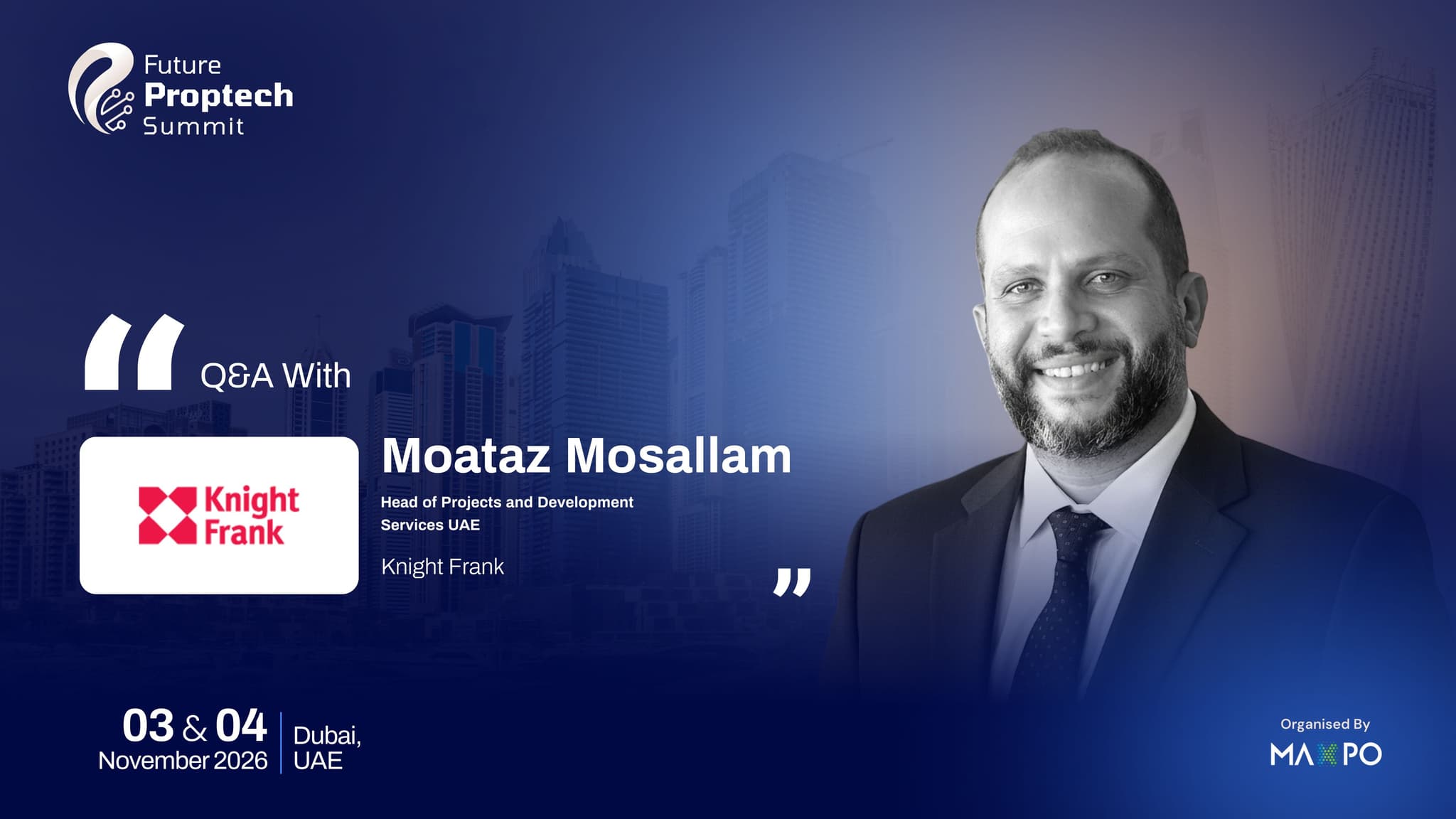
Q&A with Moataz Mosallam
By Unknown Author • Wed Jul 22 2026
1. Can you briefly tell us about your journey in the real estate industry?
My career has been built around helping clients turn ambitious ideas into
successful developments. Over the past 15+ years, I've worked across project management, cost management, development advisory, and capital planning throughout the Middle East and internationally. Today, as Partner and Head of Project & Development Services at Knight Frank MENA, I have the privilege of advising governments, institutional investors, developers, and occupiers on projects that range from individual assets to large-scale mixed-use developments. What has remained constant throughout my journey is a passion for solving complex challenges and creating projects that deliver long-term value rather than simply completing construction.
2. What excites you most about working in Project & Development Services?
The ability to influence outcomes long before construction begins. The biggest
opportunities to create value exist during the planning, feasibility, and strategic
decision-making stages. We are not simply managing projects—we are helping
clients make better investment decisions, mitigate risks, optimise costs, and
ensure developments remain commercially viable throughout their lifecycle.
Seeing a project evolve from an initial concept into a successful, operational asset is incredibly rewarding.
3. What are the biggest trends currently shaping the UAE real estate market?
The UAE market has evolved significantly over the past few years. We're seeing increasing demand for mixed-use communities, premium residential
developments, logistics and industrial assets, data centres, healthcare, and
hospitality. Sustainability is no longer optional—it has become a commercial
requirement. At the same time, investors are placing much greater emphasis on
operational efficiency, lifecycle costs, and asset performance rather than simply development costs. This shift is encouraging developers to adopt smarter planning and more technology-driven approaches.
4. How is technology changing the way real estate projects are planned and
delivered?
Technology is improving decision-making across every stage of a projec’s
lifecycle. Digital collaboration platforms, BIM, digital twins, predictive analytics,
drone surveying, and real-time project dashboards are providing stakeholders
with better visibility than ever before. Rather than reacting to issues after they
occur, project teams can identify risks early, monitor progress in real time, and
make informed decisions based on live data. This ultimately improves certainty
around cost, programme, and quality.
5. Which PropTech innovations do you believe will have the greatest impact in
the next few years?
Artificial intelligence will undoubtedly be one of the biggest game changers,
particularly in project planning, design optimisation, risk management, and data analysis. Alongside AI, I believe digital twins, IoT-enabled buildings, predictive maintenance, and integrated building management systems will transform how assets are operated after completion. The future of PropTech isn’t about introducing more technology—it’s about connecting data across the entire asset lifecycle to enable smarter decisions.
6. Why has Dubai become a leading hub for PropTech and real estate
innovation?
Dubai has consistently demonstrated a willingness to embrace innovation. The
city’s leadership has created an environment where regulation, investment,
infrastructure, and technology work together rather than independently.
Combined with one of the world's most active real estate markets, this creates the ideal ecosystem for PropTech companies to test, develop, and scale new solutions. The government’s smart city initiatives have also accelerated adoption across both the public and private sectors.
7. How do you see AI influencing the future of real estate development?
AI will become a decision-support tool across the entire development process. It will help analyse market demand, optimise designs, forecast costs, improve
procurement strategies, identify project risks, and enhance operational
performance. However, AI will complement—not replace—human expertise. Real estate development remains fundamentally about understanding people,
communities, commercial objectives, and stakeholder relationships. The greatest value will come from combining AI-driven insights with professional judgement and industry experience.
8. What role will smart buildings and smart cities play in the future of the
industry?
Smart buildings are becoming intelligent assets rather than simply physical
spaces. Through connected systems, they can optimise energy consumption,
improve occupant wellbeing, enhance security, and reduce operational costs.
When these buildings become part of connected smart cities, the benefits extend further by improving mobility, infrastructure management, sustainability, and quality of life. Ultimately, the future of real estate is not just about constructing better buildings—it is about creating smarter environments for people.
9. What advice would you give to real estate leaders looking to embrace digital
transformation?
Start with the business problem rather than the technology itself. Digital
transformation should support better decisions, improve efficiency, and create
measurable value. Invest in people as much as technology, encourage
collaboration across disciplines, and build a culture where innovation is
continuously tested and refined. Successful transformation is not achieved
through one software platform—it comes from embedding digital thinking into
the way organisations operate.
10. You were part of the first edition of Future PropTech Summit. How was your
experience, and what are you looking forward to at the 2026 edition?
The inaugural summit successfully brought together developers, investors,
technology providers, consultants, and policymakers to discuss the future of our industry. What impressed me most was the quality of conversations around
practical implementation rather than simply discussing future possibilities. For
the 2026 edition, I’m looking forward to seeing how many of those ideas have evolved into real-world applications, particularly around AI, smart cities, and digital project delivery. It’s an excellent platform for sharing knowledge, challenging conventional thinking, and building meaningful industry partnerships.
11. What is one key message you would like to share with the Future PropTech
Summit community?
Technology should never be viewed as the objective—it is the enabler. Our
industry succeeds when innovation delivers better outcomes for investors,
developers, governments, and ultimately the people who live, work, and interact within our built environment. The future belongs to organisations that combine technology, collaboration, and strong leadership to create developments that are not only smarter, but also more sustainable, resilient, and people-centred.