Q&A Session With Samit Sheth:
By Nazish Shah • Thu Jul 24 2025
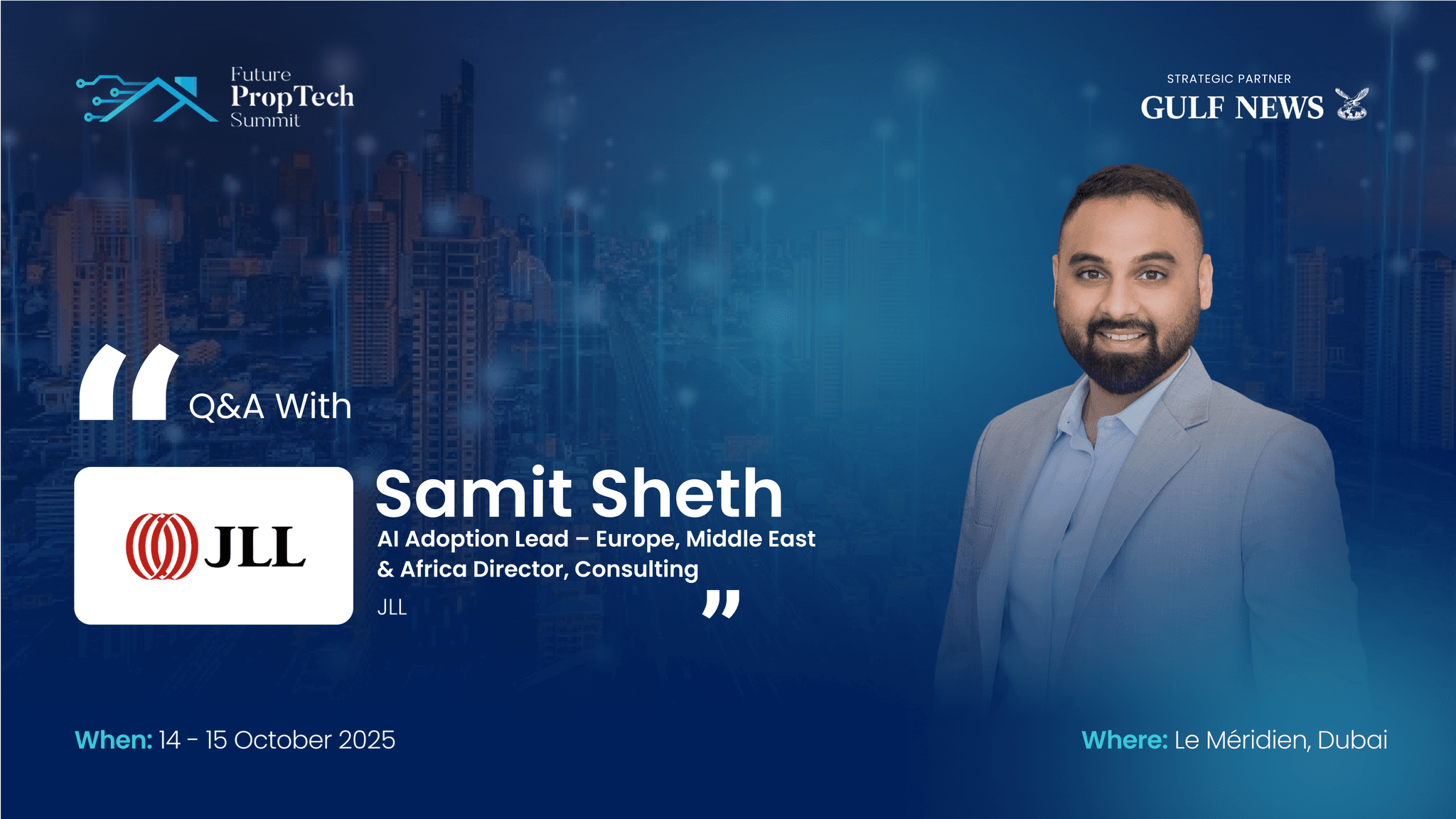
- Could you briefly introduce yourself and your role at JLL MENA?
I lead AI Strategy & Adoption for Europe, Middle East and Africa at JLL. My focus is helping real estate investors, developers, and operators reimagine the way decisions are made across the full lifecycle—from capital raising and feasibility to design, sales, and asset performance. We’re embedding AI into the operating fabric of real estate to shift from reactive processes to predictive, data-informed ecosystems. That transformation doesn’t just improve efficiency—it changes what’s possible.
2. What excites you most about the intersection of real estate and technology in the MENA region?
MENA is not evolving incrementally—it’s redefining the global blueprint for urban development. With giga-projects, sovereign-backed innovation zones, and AI infrastructure being prioritized at a national level, we have a once-in-a-generation opportunity to build intelligent cities, districts, and portfolios from the ground up.
What excites me is the ability to fuse generative design, digital infrastructure, and investment strategy into cohesive systems. We’re creating not just better buildings, but adaptive, human-centered environments shaped by real-time intelligence.
3. How does JLL MENA integrate PropTech solutions across its service offerings?
Our approach is grounded in real estate fundamentals—but elevated through AI. We support clients across:
Design and construction, where generative tools such as Alice AI reduce design friction and time / cost uncertainty
Sales enablement, with AI matching buyer profiles to pricing and inventory in real time
Community ops, where AI-native systems automate service delivery and optimize tenant satisfaction
We don’t just deploy technology—we align it to evolving operating models that prioritize speed, intelligence, and user experience.
4. What key PropTech trends are shaping the future of real estate in the GCC and broader MENA region?
Several trends are converging:
Generative design and AI-led planning, enabling mass feasibility modeling and optimization
Sales AI, accelerating absorption rates and refining conversion strategies
Embedded intelligence in operating platforms, allowing assets to self-adjust in real time
What’s different now is the institutional push behind innovation—not just from developers, but from policymakers and capital allocators. MENA is positioning PropTech as a strategic enabler of its economic and urban transformation.
5. Which PropTech innovations do you believe will have the most transformative impact in the next 3–5 years?
We’re seeing the rise of real estate operating systems powered by AI. These are platforms that don’t just report data, they act on it, automate decisions, and evolve based on outcomes.
The most transformative innovations will include:
Generative AI for early-stage planning, particularly in mixed-use developments
Predictive leasing platforms that compress absorption timelines
Self-regulating building systems that optimize energy, layout, and occupancy dynamically
These tools won’t just make real estate more efficient—they’ll unlock entirely new forms of value creation.
6. How do you see investor sentiment evolving toward smart buildings and digital infrastructure in the region?
Investor sentiment has evolved from curiosity to conviction.Today’s capital allocators expect digital infrastructure as a baseline, not a differentiator. What’s more, the launch of the DIFC PropTech Hub signals a clear message: PropTech is now a strategic pillar of regional competitiveness. It’s a physical and symbolic platform—bringing together innovators, institutional capital, and policymakers to accelerate adoption.Add to that the region’s multi-billion dollar commitment to AI innovation—and it’s clear that real estate is no longer exempt from the broader transformation underway in capital markets and digital governance.
7. Which markets in MENA do you see as emerging PropTech hotspots, and why?
Saudi Arabia is shaping a new language of real estate innovation—from cognitive cities to AI-regulated infrastructure.
Abu Dhabi is doubling down on sovereign innovation, linking capital with R&D and climate intelligence.
DIFC in Dubai is actively creating the connective tissue—bringing together PropTech startups, developers, and investors under one roof.
8. What are some challenges traditional real estate firms face when adopting PropTech and how can they overcome them?
The real challenge isn’t technology, it’s alignment. Many firms struggle to:
Translate ambition into commercially grounded use cases
Bridge the gap between IT, design, and investment teams
Define what digital success looks like
Place the right level of emphasis on Adoption, through change management and transformation initiatives.
Our recommendation: treat AI and PropTech as strategic programs, not tactical projects. Start with a clear problem, attach measurable business outcomes, and evolve the operating model—not just the toolset.
9. What are you hoping to gain or contribute through your participation at the Future PropTech Summit?
I’m here to challenge the idea that innovation in real estate is a tech problem. It’s a strategic opportunity—to rewire how capital is deployed, how cities are shaped, and how users experience space.
My contribution is to offer clarity in a market full of noise. To bring together design, finance, data, and experience into one forward-looking conversation. I’m not just interested in what’s new—I’m focused on what’s next, and what scales.
Because the leaders who understand that convergence—and build toward it—will shape the next generation of real estate.
10. If you could give one piece of advice to upcoming PropTech entrepreneurs in the region, what would it be?
Embed within the ecosystem. Don’t pitch solutions—solve problems that matter to capital, construction, leasing, or community. Understand the real estate lifecycle and show how your product reshapes a decision or accelerates an outcome.
Distribution is earned through trust—and trust is built by proximity to the problem.
Looking ahead, how do you see both your role and JLL’s approach evolving as PropTech becomes increasingly integral to the industry?
My role will increasingly focus on integrating intelligence into the real estate operating model—where AI supports not just decisions, but strategic coordination between capital, design, experience, and sustainability.
For JLL, it means becoming a transformation partner—not just a service provider. We’ll help our clients build intelligent, resilient, human-centered portfolios—by designing, testing, and scaling the infrastructure that makes future real estate viable today