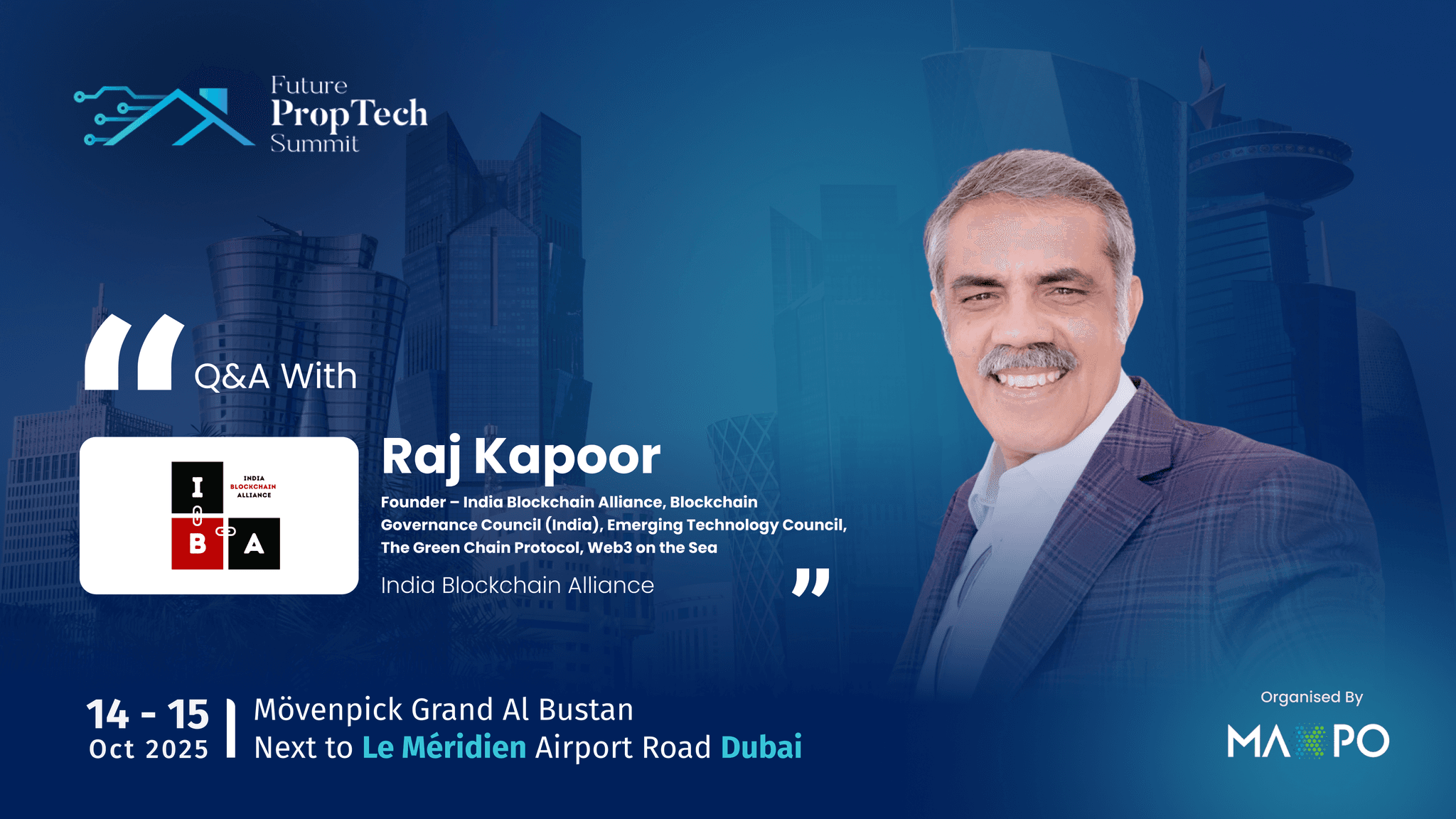
Q&A Session With Raj Kapoor
By Urwa A. Beigh • Mon Sep 15 2025
1) Blockchain’s impact on real estate (Dubai & India)
Blockchain is transforming real estate in both Dubai and India, but the trajectory differs sharply because of the starting conditions. In Dubai, where land registries are already centralized and digital-first, blockchain is the natural next step—it makes ownership verification instant, reduces settlement timelines from weeks to hours, and embeds compliance directly into transactions. Think of it as adding an immutable audit trail to an already streamlined ecosystem. India, by contrast, faces a far messier challenge: fragmented land records, inconsistent state-level systems, and a history of
title disputes. Here, blockchain isn’t just an upgrade, it’s a potential cure—creating a single source of truth that captures every mutation, mortgage, or lien in an unalterable chain of events. The result is that both markets converge towards the same outcome—faster, safer, and more transparent transactions—but through very different routes: Dubai exemplifies efficiency scaling to global capital markets, while India demonstrates how trust less infrastructure can fix systemic opacity and restore confidence in one of the world’s most complex property ecosystems.
A few live pilots already illustrate how blockchain is beginning to reshape real estate in Dubai and India, and they make the conversation far more tangible.
In Dubai, the Dubai Land Department (DLD) has been a global first mover. As early as 2017, it launched a blockchain-powered platform that integrates with government entities, banks, and utilities to create what is essentially a “single window” for property transactions. Today, buyers can verify ownership, register a property, settle payments, and even update their DEWA (Dubai Electricity and Water Authority) account seamlessly through a blockchain layer. This is not theory it has reduced paper-based inefficiencies and built investor trust in Dubai’s global real estate brand.
India, on the other hand, has approached the challenge through state-led pilots. The state of Andhra Pradesh was one of the first to experiment with blockchain-based land records, working with startups to digitize and secure property registries. Maharashtra followed with blockchain-linked e-registration for property agreements, designed to reduce disputes and fraud in its notoriously complex real estate market. More recently, Haryana has tested blockchain-backed land record systems to bring consistency across district-level registries. These aren’t yet at Dubai’s scale, but they are crucial proofs of concept for a country with vast legacy baggage in its land administration.
The lesson is clear: Dubai demonstrates what’s possible when a regulator moves decisively with centralized authority, while India shows the messy but necessary pathway of incremental adoption through state-level pilots. Both paths converge toward a future where blockchain delivers efficiency, transparency, and trust to real estate markets—but one builds on efficiency, and the other repairs opacity.
2) Tokenization & fractional ownership—how close, what hurdles?
Tokenization and fractional ownership have moved well beyond buzzwords, but we are still a few steps away from genuine large-scale adoption. At a conceptual level, the promise is irresistible: by breaking a $10 million office tower into compliant digital tokens, you democratize access, attract a broader investor base, and unlock liquidity in what has traditionally been one of the world’s most illiquid asset classes. The infrastructure for this vision is no longer speculative—regulated custodians exist, token standards have matured, and compliant marketplaces are being piloted in Dubai, Singapore, and Europe. But the hurdles are not trivial. The regulatory ambiguity around whether real estate tokens constitute securities remains the single biggest bottleneck, particularly in India, where property law itself is fragmented across states. Then there is the question of valuation transparency, tokenization is only credible if supported by reliable oracles for rent flows, expenses, and NAV updates, something the market is still building. Secondary liquidity is another missing piece: without broker-dealer connectivity, market makers, and standardized disclosure packs, fractional units risk becoming illiquid “digital paperweights.” Finally, investor distribution poses a challenge, global investors want seamless onboarding, but KYC/AML regimes vary sharply across jurisdictions.
So how close are we? Institutional pilots are already live—Dubai International Financial Centre (DIFC) has licensed players experimenting with tokenized funds, and India’s GIFT City is exploring sandboxes for asset-backed tokens. Large-scale retail adoption, however, is likely to be gradual, beginning with private credit and RWA funds, then moving into stabilized, income-generating REIT-like tokens before finally opening up to mainstream fractional ownership at the retail level. In other words, the rails are being laid, but the train is still building momentum.
Investor appetite is, in fact, one of the most telling indicators of where tokenization and fractional ownership stand today and the contrast between Dubai and India is revealing.
In Dubai, the appetite is palpable. The city has positioned itself as a global wealth hub, attracting high-net-worth individuals and institutional capital from Europe, Asia, and the Middle East. Tokenized real estate offerings have begun to capture attention, particularly for premium residential and commercial assets that international investors already covet. The DIFC’s regulatory sandbox and the Virtual Assets Regulatory
Authority (VARA) framework give global investors confidence that these products will not vanish into a legal vacuum. We are seeing family offices and private funds explore tokenized income strips, where rental yields are fractionalized and sold as programmable digital securities—effectively creating a new asset class that blends real estate stability with digital liquidity.
India, by contrast, is at a more cautious stage. Global investors recognize the sheer size of the Indian real estate market—estimated at US$1.3 trillion by 2034 but they remain wary of the country’s legal complexities and the lack of a unified regulatory stance on tokenization. Appetite is strongest for pilots in the GIFT City IFSC zone, which operates under a globally aligned financial framework and is positioning itself as India’s “sandbox for the world.” Here, offshore funds and fintech players are exploring tokenized debt and fractional ownership of commercial real estate. Domestic investors
are also beginning to show interest, particularly younger, tech-savvy segments, but until regulators clarify how these tokens map to enforceable ownership rights, mass adoption will remain aspirational.
The larger picture is that Dubai attracts early movers because of clarity and branding as a global digital asset hub, while India tempts long-term investors because of scale and latent demand. In many ways, investor appetite today mirrors the infrastructure itself: Dubai is sprinting ahead with visible traction, while India is laying down foundations for what could become one of the largest tokenized real estate markets in the world once the fog of regulation clears.
3. Dubai has positioned itself as a global smart city hub. What lessons can
India take from Dubai’s PropTech journey, and vice versa?
Dubai’s smart city journey has been audacious and instructive. Since launching its “Smart Dubai” initiative in 2013, the city has rolled out over 100 integrated projects across government services, mobility, and infrastructure. Citizens transact through unified apps like DubaiNow and mPay, and even buildings come embedded with QR-coded digital identities . If you’re a real estate investor or developer, you know that streamlined governance reduces friction and builds confidence two things every property market craves.
On the mobility front, the Roads & Transport Authority (RTA) is deploying AI- and IoT-powered systems—think real-time traffic signal controls and smart transports—and aims to automate 25% of all journeys by 2030 . For real estate, that means better access, more liveable neighbourhood, and rising valuations around smart corridors.
Dubai’s leadership isn’t shy about leading with tech. They appointed the world’s first AI Minister, embedded an AI ethics framework built on humanity, security, ethics, and inclusion, and achieved complete paperless governance through the Smart Dubai 2021 initiative . The result? A high-trust, innovation-first environment exactly where property technologies flourish.
The Dubai Land Department (DLD) has catalyzed this by turning Dubai into the “Silicon Valley of real estate” a live lab for PropTech innovators via conferences like Step, and partnerships with startups and global investors .
India’s PropTech scene doesn’t rely on grandeur or mass QR codes. Instead, it’s grounded in real-world scale, resilient infrastructure, and grassroots innovation.
Take NoBroker, a Bengaluru-based PropTech unicorn. It disrupted traditional
brokerage, morphed into an ops management superapp, and even plugged into India’s national digital commerce infrastructure (ONDC). This low-cost, mass-market play serves millions across tier-1 to tier-3 cities, something Dubai’s luxury-first model doesn’t need to scale for.
Or consider GIFT City, India’s greenfield smart city and financial hub. It’s already operational, with centralized district cooling, automated waste systems, fintech, and international banks all bridging urban planning with financial innovation . This convergence of infrastructure with global capital markets is a leap in urban real estate vision on India’s terms.
Dubai teaches India to design cities and real estate markets that are smart by default: digitally interoperable, data-driven, and innovation-primed. India teaches Dubai the value of inclusive scale lean, modular, consumer-first propulsion, enabled by digital rails grounded in public infrastructure.
One builds the future; the other builds it for everyone.
4. How can blockchain ensure transparency and trust in property ownership
and land records, especially in countries with complex real estate
frameworks like India?
Blockchain can turn land administration from a maze of paper trails into a verifiable, tamper-evident system of record—crucial in countries like India where titles, mutations, and encumbrances are dispersed across departments and states. The core idea is event-sourcing: every legally relevant action—sale deed registration at the sub-registrar, mutation at the revenue office, creation or release of a bank charge, court stay orders, even municipal NOCs—becomes a time-stamped, digitally signed transaction on a shared ledger. Instead of trusting a single database (or a clerk’s entry), buyers, lenders, and courts can verify a property’s lineage end-to-end as a
cryptographically linked chain of events. This ledger doesn’t replace existing IT systems overnight; it anchors their outputs. PDFs of RoR/7-12 extracts, encumbrance certificates, and cadastral maps carry embedded hashes that can be checked against the chain, so any later alteration is obvious.
Trust improves not only through immutability but also through identity, permissions, and privacy done right. Parcels and actors get decentralized identifiers (DIDs); officials, banks, and notaries sign transactions with role-based keys, creating non-repudiable accountability. Sensitive fields—owner KYC, consideration amounts—can be selectively disclosed using zero-knowledge proofs or encrypted payloads, so transparency doesn’t mean doxxing. Oracles tie the ledger to the physical world: geotagged cadastral surveys, utility connections, and property tax records attest that a parcel exists where the paperwork claims it does. Smart-contract workflows then automate compliance—e-stamp validation, KYC/AML checks, lien checks before mutation—so errors are prevented up front rather than litigated later.
The migration path matters as much as the technology. Start by hashing legacy records to create a “golden record” without changing legal processes; then move high-risk steps (encumbrance creation, court orders) on-chain; finally, shift full conveyance and mutation to smart contracts with statutory recognition.
Interoperability is the lubricant: use open schemas so land, banking, courts, and municipalities can read the same state, and mandate digital signatures from every official touchpoint. To guard against “garbage-in,” pair on-chain entries with independent attestations (bank APIs for charges, tax receipts for occupancy, surveyor signatures for boundary changes) and mandate periodic reconciliations. The payoff is practical: faster lending because banks can underwrite from a single tamper-evident history; fewer disputes because every change is attributable and time-stamped; and better governance because audit becomes a read operation, not an investigation. In short, blockchain doesn’t magically solve land complexity—it disciplines it, turning fragmented paperwork into verifiable provenance that all stakeholders can trust.
5. With AI and blockchain converging, how do you see PropTech evolving
over the next five years?
PropTech is on the cusp of a radical shift as artificial intelligence and blockchain converge over the next five years. The most visible transformation will come in how real estate assets are bought, sold, and managed. Blockchain will make tokenization and fractional ownership mainstream, turning traditionally illiquid properties into tradeable digital assets. With AI layered on top, due diligence, valuation, and risk assessments will become automated, removing friction from transactions and broadening access for retail investors. This convergence will not just democratize ownership but also deepen trust and compliance in an industry long burdened by inefficiencies.
At the same time, the property experience itself will be reimagined. AI-powered personalization will match tenants and buyers with homes and workspaces tailored to their preferences, while blockchain-secured datasets will ensure that the recommendations are based on accurate and tamper-proof information. Buildings will increasingly be managed through AI-driven digital twins that predict maintenance, optimize energy use, and enhance tenant comfort. Smart contracts will automate lease terms, rent collection, and service agreements, cutting down on disputes and
delays.
The impact will be even more profound in regions where land governance remains opaque. Blockchain-based registries, enhanced with AI fraud-detection models, will offer transparent and incorruptible records of ownership, reducing disputes and speeding up property transfers. Parallelly, sustainability pressures will reshape PropTech: AI will monitor energy consumption and carbon footprints in real time, while blockchain will provide immutable proof of ESG compliance, making environmentally friendly properties more attractive to investors through tokenized
credits and green bonds.
In essence, PropTech is evolving from a digitally enhanced sector into a self-optimizing ecosystem. Transactions will become smarter, assets more liquid, operations increasingly autonomous, and governance far more transparent. The companies that thrive will be those that fuse AI’s predictive intelligence with blockchain’s trust infrastructure, creating systems that are efficient, inclusive, and future-ready.
6. What role do you see alliances like the India Blockchain Alliance and the
India AI Alliance playing in global PropTech innovation?
Alliances such as the India Blockchain Alliance and the India AI Alliance will play a catalytic role in shaping global PropTech innovation over the next five years. Their most immediate contribution lies in standard-setting and regulatory dialogue. By working closely with policymakers, industry stakeholders, and international bodies, these alliances can harmonize compliance frameworks for tokenized real estate, AI-driven property management, and blockchain-enabled land registries. This is crucial in
a sector where regulatory uncertainty often slows down adoption.
They will also serve as bridging ecosystems, connecting India’s rapidly growing PropTech startups with global capital, technology partners, and knowledge networks. Through advocacy, accelerators, and consortium pilots, such alliances can position India not only as a user of PropTech solutions but as a global exporter of frameworks and platforms that are scalable in both developed and emerging markets.
Another critical role will be in capacity-building and skill development. PropTech requires cross-disciplinary expertise in real estate, law, data science, AI, and blockchain. Alliances provide structured education, certification, and training programs that ensure India builds a skilled talent pool capable of running and scaling next-generation PropTech ventures. This will strengthen India’s credibility as a PropTech innovation hub for the Global South. Finally, these alliances will drive collaborative innovation, creating sandboxes where AI and blockchain startups can co-develop
interoperable solutions. Whether it is carbon-neutral smart buildings, decentralized real estate marketplaces, or AI-enabled compliance tools, the India Blockchain Alliance and India AI Alliance can anchor pilots that later become global blueprints.
In essence, these alliances are not just industry bodies—they are innovation
orchestrators, ensuring India’s voice, solutions, and leadership are deeply embedded in the future of PropTech worldwide.
7. PropTech is increasingly tied to sustainability. How can technologies like
digital twins,AI, and blockchain reduce the environmental footprint of real
estate projects?
Sustainability is becoming the defining lens for PropTech, and the convergence of digital twins, AI, and blockchain is poised to radically cut the environmental footprint of real estate projects. Digital twins—virtual replicas of buildings and infrastructure—allow developers and operators to simulate construction processes, energy flows, and occupancy patterns long before ground is broken. This means inefficiencies, material wastage, and high-carbon design choices can be identified and corrected early. Once
operational, these twins act as living models, enabling continuous optimization of heating, cooling, ventilation, and lighting to drive down energy consumption. AI builds on this by bringing predictive intelligence into sustainability. Machine learning models can analyze vast streams of IoT and sensor data to forecast peak energy demand, recommend retrofits, or predict maintenance before resource-intensive failures occur. AI can also dynamically adjust energy systems, water usage, and waste management, creating buildings that “self-optimize” for environmental performance while maintaining tenant comfort.
Blockchain adds a layer of trust and accountability to these sustainability measures.
Immutable ledgers can track and verify everything from sourcing of green
construction materials to real-time carbon emissions and renewable energy credits.
For investors and regulators, this provides transparent ESG reporting that cannot be manipulated. Blockchain can also power tokenized carbon credits, enabling real estate projects to monetize efficiency gains and reinvest in further sustainability upgrades.
Together, these technologies create a closed loop of design, operation, and
accountability: digital twins visualize sustainability scenarios, AI ensures ongoing optimization, and blockchain guarantees integrity in measurement and reporting. This synergy not only reduces energy consumption and emissions but also makes sustainable real estate projects financially attractive, as investors increasingly demand verifiable green credentials.
8. From your global collaborations, which PropTech use cases excite you the
most today, and why?
Several PropTech use cases stand out as particularly exciting because they embody the convergence of AI, blockchain, and sustainability. One is the rise of fractional ownership and tokenized real estate markets. In Dubai, Singapore, and parts of Europe, platforms are already piloting blockchain-based real estate investment vehicles that allow investors to buy fractions of commercial or residential assets. What excites me is not just the democratization of access, but also the liquidity and transparency these models bring to a historically illiquid sector.
Another powerful use case is AI-driven digital twins for urban planning and
sustainable building management. Cities like Singapore and Helsinki are building national-level digital twin frameworks that integrate IoT, AI, and simulation models to predict energy demand, optimize resource allocation, and even plan climate-resilient infrastructure. This is thrilling because it shifts PropTech from being reactive to proactive—buildings and cities that self-correct to minimize environmental impact.
A third emerging frontier is blockchain-backed land registries and title management in markets with weak governance frameworks, such as parts of Africa and South Asia.
These projects excite me because they address deep systemic issues: land disputes, corruption, and inefficiencies in property transfers. By combining blockchain immutability with AI fraud detection, these systems are not just digitizing records but rebuilding trust in ownership itself.
Lastly, I’m particularly intrigued by PropTech’s role in ESG-linked financing. AI models are already evaluating energy efficiency and carbon footprints of properties in real time, while blockchain is ensuring verifiable, tamper-proof ESG reporting. This allows developers to raise green bonds or trade tokenized carbon credits tied directly to their buildings’ performance, aligning capital markets with sustainability goals.
These use cases excite me because they go beyond incremental efficiency—they redefine how we own, govern, and sustain real estate globally, turning PropTech into both a financial innovation and a climate solution.
9. How can governments and regulators in Dubai, India, and elsewhere build
frameworks that balance innovation with ethical safeguards in PropTech?
Governments should treat PropTech like a “cyber-physical” sector—where code meets concrete—and regulate accordingly. Start by pairing permissioned sandboxes (for tokenized ownership, AI leasing, digital-twin ops) with clear exit criteria into production, so innovators can ship while supervisors learn in real time. Require privacy-by-design and consent for all occupant/tenant data (purpose limitation, minimization, deletion rights), plus algorithmic accountability: model cards, bias testing on tenant-facing AI (screening, pricing, maintenance prioritization), and independent audits for safety and fairness. Mandate secure-by-default infrastructure (BIM/digital-twin hardening, incident reporting, red-team drills for building systems),
and verifiable ESG: standard metrics for energy, water, waste, and an MRV trail (digitally signed logs; blockchain optional but acceptable) that underpins green incentives and bonds. For market integrity, define tokenization rules aligned with securities/REIT law (KYC/AML, disclosures, custody, oracles, secondary trading), require on-chain/off-chain escrow for rents and service guarantees, and codify interoperability via open schemas (IFC/gbXML, open ledger standards) so assets and data can move across platforms.
Dubai can leverage its single-window style governance to move fastest: align RERA/DLD rules with VARA-style clarity for tokenized real estate, issue a Digital-Twin Code (BIM levels, cyber baselines, approved sensor stacks), and tie Estidama/green-building incentives to auditable performance data, not paper checklists. A cross-agency PropTech sandbox—Municipality, Energy, Utilities, Civil Defence—can pre-clear models for safety, fire, and grid impacts, while a city data trust gives startups privacy-preserving access to anonymized mobility, climate, and utilities data for better models.
India should anchor PropTech to DPDP-compliant data flows and the India Stack (Aadhaar-based KYC where lawful, Digilocker for title/drawings, e-sign for closings).
Use RERA as the spine to pilot blockchain registries and e-escrow for projects, publish BIS reference standards for tokenized assets and digital-twin security, and create state-level sandboxes (GIFT City, iStart-style hubs) for cross-border PropTech capital.
A Green Taxonomy tailored to Indian climates—paired with MRV rails—can unlock concessional finance for retrofits and affordable housing, while public procurement (CPWD/Smart Cities Mission) seeds demand for open, auditable PropTech. Everywhere, the balance is the same: principle-based guardrails + testable technical standards + interoperable data. Regulators set the north star (safety, fairness, resilience, transparency); sandboxes and audits make it real; open standards prevent lock-in; and outcome-linked incentives pull the market toward sustainable, ethical innovation.
10. What advice would you give to PropTech startups in India or Dubai
looking to attract global investors?
For PropTech startups in India or Dubai aiming to attract global investors, my advice is to focus on clarity, credibility, and differentiation. The first priority is to present a clear regulatory alignment story. Investors are wary of markets with uncertain property and tokenization laws. Demonstrating compliance with frameworks such as RERA in India, VARA/DLD in Dubai, or relevant sandbox licenses reassures them that you understand the legal landscape and are building with safeguards in mind.
Equally important is to show global scalability with local grounding. Highlight how your solution addresses specific challenges in India or Dubai—land registry transparency, green building mandates, or affordable housing—but is also exportable to other markets. Investors are attracted to platforms that can serve as both regional case studies and global blueprints.
You should also emphasize sustainability and ESG alignment. Global investors are increasingly channeling capital into green real estate. If your startup leverages AI and blockchain for energy efficiency, carbon tracking, or verifiable ESG reporting, make that a central part of your pitch. Pair the technology with quantifiable environmental impact, since hard numbers resonate more than aspirations.
Finally, invest in storytelling backed by strong unit economics. Many PropTech founders focus on technology but underplay the financial model. Show how tokenization creates liquidity, how AI-driven efficiencies reduce operating costs, or how blockchain-enabled transparency lowers transaction risks. Complement this with a credible roadmap, partnerships, and early traction—whether in pilot projects, developer collaborations, or government initiatives.
Global investors aren’t just looking for smart tech—they’re looking for trusted operators who can scale responsibly in one of the world’s most asset-heavy industries.
If you can demonstrate that balance of innovation, compliance, and impact, you’ll stand out in the global PropTech race.
11. How do you see cross-border blockchain initiatives in real estate creating
new opportunities for global property investment?
Cross-border blockchain initiatives in real estate are set to redefine the contours of global property investment. At their core, these initiatives break down the barriers of geography, regulation, and liquidity that have historically kept real estate local. By using blockchain to tokenize assets, property ownership can be represented as digital shares that are accessible across jurisdictions. This creates a framework where an investor in Dubai can seamlessly buy into a fractional stake of a residential project in Mumbai, or a fund in Singapore can diversify into European commercial properties without the red tape of cross-border conveyancing.
The opportunities lie not just in liquidity and accessibility, but also in trust and transparency. Smart contracts embedded in these initiatives can automate compliance with local laws, while blockchain’s immutable ledger ensures that ownership, cash flows, and ESG metrics are verifiable across markets. This reduces the risk premium traditionally associated with investing in unfamiliar geographies. Moreover, such frameworks can integrate with stablecoins or CBDCs, enabling real-time, low-cost settlement of cross-border property trades—something the traditional banking system still struggles to deliver.
Equally transformative is the role of these initiatives in diversification and inclusivity. Smaller investors, who were historically excluded from global property markets due to high entry costs, can now participate in fractionalized assets. Institutions, on the other hand, can build diversified, blockchain-verified portfolios across continents with far lower operational overheads.
In the long run, cross-border blockchain PropTech could evolve into a new asset class altogether—globally tradable real estate securities underpinned by AI for risk assessment and blockchain for compliance. For regions like Dubai and India, which are already experimenting with tokenized real estate sandboxes, the potential is to position themselves as gateways for global investors seeking transparent, liquid, and sustainable property exposure.
12. What’s your vision of how real estate will look by 2030 with the
integration of AI, blockchain, and sustainable practices?
By 2030, real estate will look and feel dramatically different, shaped by the fusion of AI, blockchain, and sustainability-first practices. Properties will no longer be static assets but intelligent, adaptive ecosystems. Every building will likely have a digital twin—a living, AI-powered simulation that continuously monitors structural integrity, energy consumption, and occupancy. These twins will predict maintenance, optimize resources, and adapt to environmental conditions, ensuring buildings operate with
minimal waste and maximum efficiency. On the transactional side, blockchain will normalize tokenized property markets, making fractional ownership mainstream. Real estate portfolios will resemble stock portfolios, with investors trading fractional stakes in global assets seamlessly through cross-border blockchain platforms. Title deeds and land registries will exist on tamper-proof ledgers, dramatically reducing fraud and unlocking trust in markets where governance has historically been opaque. Combined with central bank digital currencies (CBDCs) or stablecoins, cross-border settlements for property trades will be near-instant and low-cost. Sustainability will no longer be a marketing differentiator—it will be a financial imperative. AI will monitor carbon footprints in real time, while blockchain will provide verifiable ESG credentials. Buildings will not only comply with green mandates but also participate in tokenized carbon markets, generating revenue from their efficiency gains. Smart cities will tie property tax incentives and financing rates directly to verified ESG performance, rewarding buildings that achieve net-zero or positive environmental outcomes.
By 2030, real estate will evolve into a self-regulating, transparent, and sustainable ecosystem. Investors will move capital seamlessly across borders, tenants will live and work in buildings that adapt to their needs while minimizing environmental impact, and developers will compete not just on location and design, but on verified sustainability and technological intelligence. In short, the industry will shift from being capital-heavy and opaque to being digitally liquid, transparent, and climate-conscious a reinvention of real estate as both a global asset class and a driver of sustainable urban living.